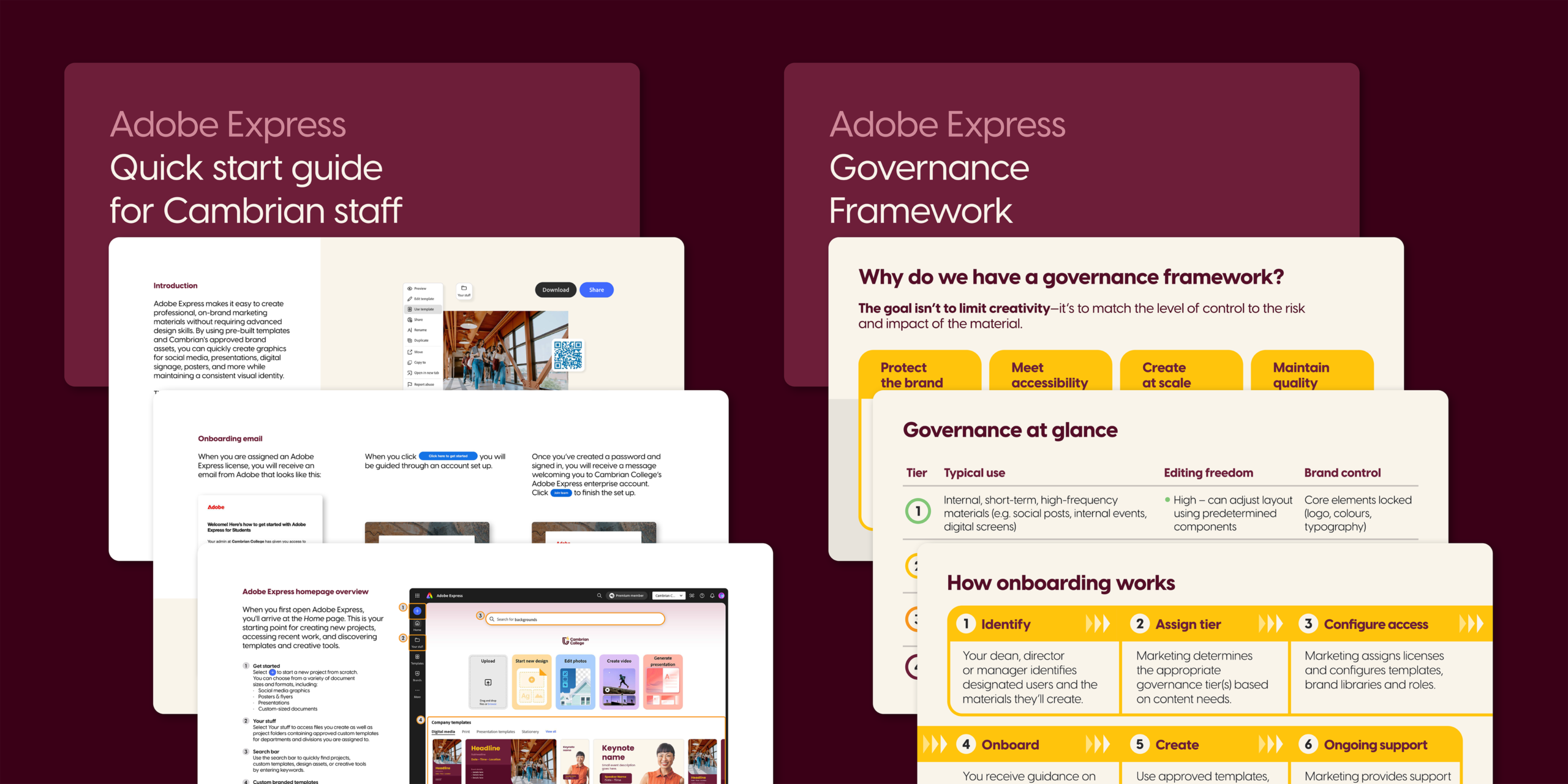
Adobe Express Governance
Cambrian had hundreds of staff and faculty who needed to create communications materials, but not everyone had access to professional design software or formal design training. The challenge was to enable fast, self-service content creation without compromising the visual identity established through the college’s 2024 rebrand.
I led the development of an Adobe Express governance framework that defined how the platform would be structured, who could create and manage templates, how templates would be reviewed, and which types of communications should remain within the professional design workflow.
The goal was not simply to create a library of templates, but to establish a scalable system that balanced brand control, accessibility, flexibility, and creative capacity.
Client
Cambrian College
Disciplines
Design Systems, Design Governance, User Research, Usability Testing, Brand & Content Strategy
Governance
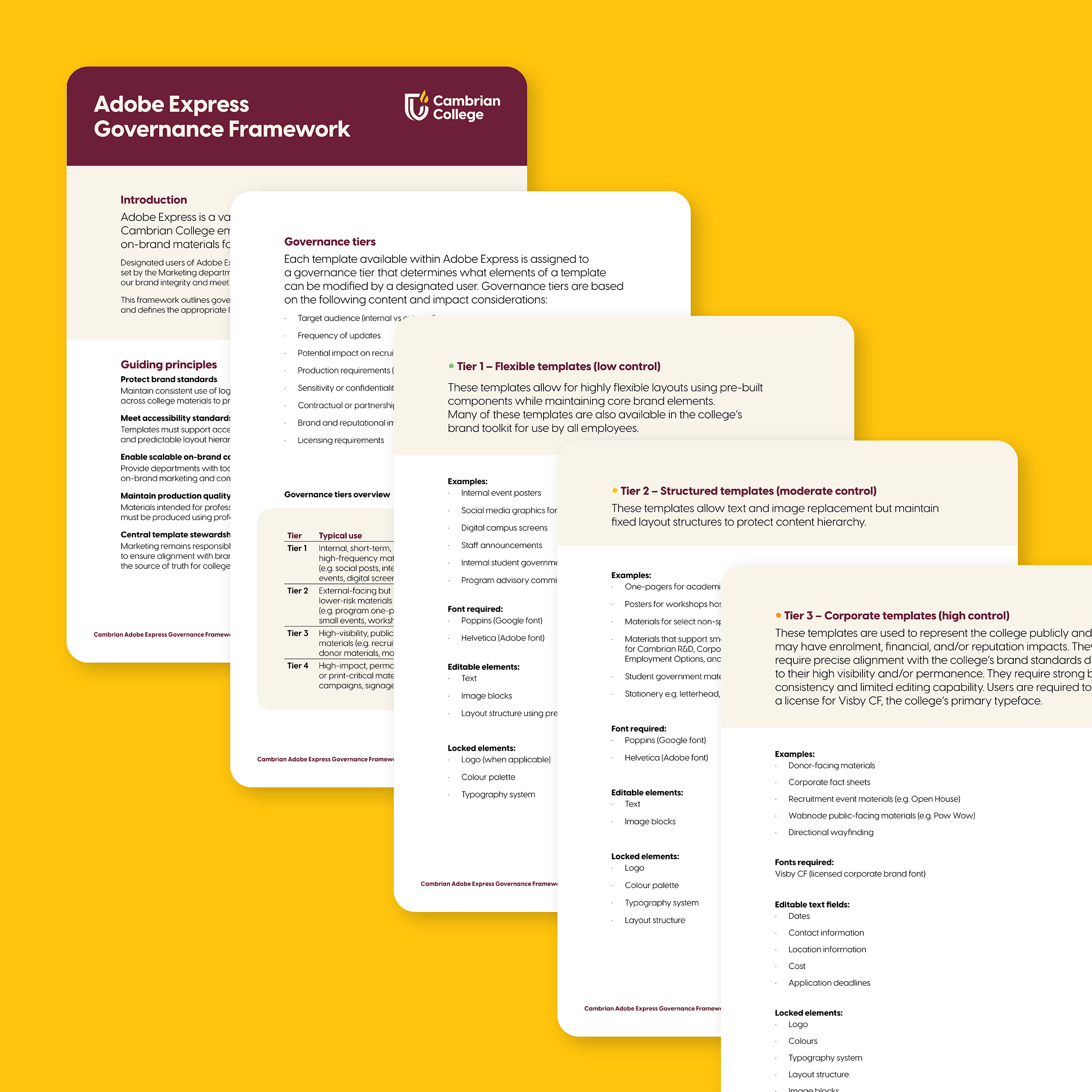
I developed a tiered governance model that determined how much creative freedom users should have based on the visibility and impact of the communication.
Tier 1–2 templates support internal, lower-visibility, and lower-recruitment-impact communications. These templates provide greater editing flexibility and use Poppins, a free alternative to Cambrian’s primary corporate typeface, Visby CF.
Tier 3 templates are used for public-facing communications and materials with greater recruitment impact. These templates use Visby CF and lock down most visual elements, while allowing users to modify essential content such as dates, text, and photography.
Tier 4 represents communications that should not be templated. Materials that require a higher degree of creative direction, brand expression, or strategic consideration remain within the professional design workflow.
This created a simple principle: the greater the impact of a communication, the greater the level of design control. The framework allowed Adobe Express to support the quick-turnaround communications promised as part of the brand launch, without treating every communication as though it carried the same level of brand risk.
System
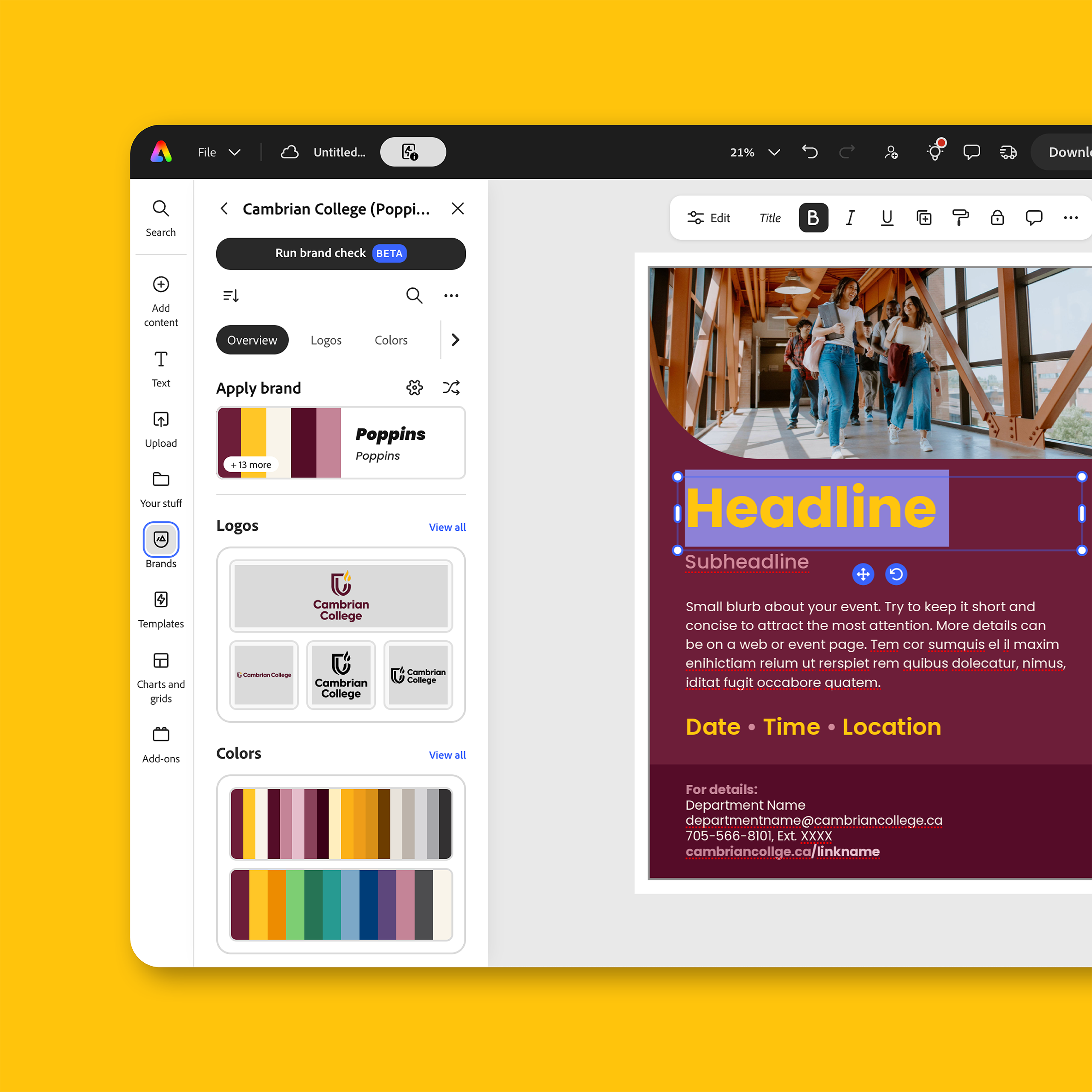
I helped establish the underlying Adobe Express system and was identified as an administrator responsible for provisioning user licences and managing the platform’s branded environment.
The Adobe Express homepage was configured with Cambrian’s logo and brand colours, alongside quick access to custom-branded templates. Adobe’s generic template library was intentionally de-emphasized from the homepage, directing users toward approved Cambrian templates while still preserving the flexibility of the broader Adobe Express platform.
Rather than attempting to restrict users from using external templates entirely, the system was designed around education and guardrails. Onboarding showed users how to quickly apply Cambrian’s brand to Adobe Express templates when appropriate, while the governance framework established which communications should use more controlled custom templates.
This approach recognized that effective governance is not simply about restriction—it is about creating a system in which the easiest path is also the most on-brand path.
Testing & Iteration
Before broader implementation, we conducted small-scale testing with a core group of internal users.
Testing revealed practical issues that were not apparent during the initial system configuration. Some users encountered confusion when choosing between personal and Cambrian College profiles to access custom-branded templates, while others could not see the customized Adobe Express homepage at all.
These issues required troubleshooting with Adobe and, in some cases, intervention from Adobe developers. The testing process allowed us to identify and resolve these friction points before expanding the system more broadly.
The work reinforced an important principle of the governance model: a system is only successful if the people using it can actually navigate it.
Results
The result is a scalable self-service design system consisting of custom-branded templates, graphics, and imagery that staff can use to produce quick-turnaround communications while maintaining a cohesive visual identity.
The governance framework provides different levels of creative freedom depending on the strategic importance of the communication. Brand controls protect the elements that should remain consistent, while editable areas give users enough flexibility to respond to their day-to-day communication needs.
This extends the reach of the design team beyond the work we can produce directly. Staff who have little or no formal design experience can create materials that still feel recognizably Cambrian.
At the same time, the system helps protect the creative team’s capacity for higher-value work—allowing us to spend less time producing routine communications and more time on strategic brand development, digital experiences, design systems, and other complex creative projects.
Ultimately, the project transformed Adobe Express from a generic self-service design tool into a governed extension of Cambrian’s brand system.